PROJECT MANAGER ESSENTIALS
SCHEDULE MANAGEMENT
A critical part of the project is time management. Schedule management primarily consist of preparing a schedule and controlling it. The section below highlights on techniques used to make a schedule that is beneficial for projects and also ways of monitoring the progress of the project.

STEPS TO FOLLOW (Luecke, Press, and Review, 2004):
-
Identify and define activities through WBS.
-
Examine the relationships between tasks.
-
Draft a schedule
-
Optimise a schedule.
Preparing the Schedule
Activities-
Once the WBS (Work Breakdown Structure is made, work packages can be further divided to create small activities which are easily assignable and manageable. This could be done through simple decomposition of work packages or by Rolling wave planning. In this type of planning, the work in the near term is planned in detail and a high level activity is defined for activities in future which are uncertain.
The activities are usually listed and relationships are created between these activities.

Some scheduling softwares that can be used:
-
MS Project
-
OpenProj
-
Primavera

Sequencing Activities-
A well sequenced set of activities can lead to greater efficiencies. There are a few ways in which this can be done.
1. Precedence Diagramming Method (PDM) -
This is a PERT ( Planning, Evaluation and review technique) tool to construct a schedule model. AON (Activity on node) is the most common way of using this.
It helps understand activity dependencies visually.
Four ways in which the dependencies can be shown are:
1. Finish to start (FS) - This is the most commonly used method
2. Finish to Finish (FF)
3. Start to start (SS)
4. Start to Finish (SF)
Some other useful terms:
To determine accurately show logical relationships between activities lead and lag are used (PMBOK, 2013);
LEAD- A successor activity can be advanced with respect to predecessor.
LAG- A successor activity will be delayed with respect to predecessor activity.
The figure below (PMBOK, 2013) shows examples of lead and lag.


(PMBOK,2013)
2. Critical Path method
The critical path comprises of the set of tasks that determines the total project duration. Any delays on this path would create delays in the project.
This path has zero float!
Total Float = Maximum amount of delayed or extended time that does not delay projects. ( PMBOK, 2013)
It is important to note that the critical path does not need to flow from the start to the end of the project. It could be the final milestone or anywhere in the schedule.
During planning, critical path is a useful way to estimate if the project can be completed as per schedule. During the rollout of the project, the critical path can be used to analyse the areas of concern (Hartley, 2008).


Critical Chain Method
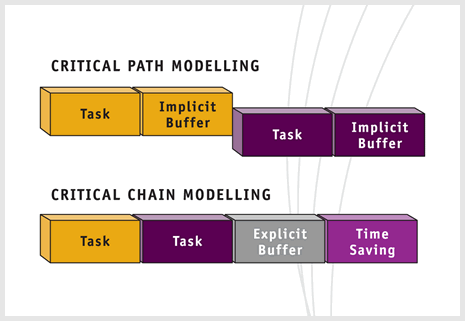
An alternative approach to managing slack is the Critical chain method or Critical Chain Project management (CCPM). Eliyahu Goldratt who wrote about the 'Theory of Constraints' coined the term (Gray and Larson, 2014).
This is the largest chain of dependencies which involves tasks and resources. That are several explanations that are offered by Critical Chain Project Management-
1. Parkinson's law: The time available is filled with work. Specially in environments where a backlog of work occurs.
2. Self protection- Failure to report completed work early.
3. Dropped Baton - this is due to poor communictaion and inflexible resources.
4. Excessive Multi tasking- Resources work on several projects in one timeframe.
5. Resource bottlenecks - As some resources are busy at times , the dependent resources suffer.
6. Student Syndrome ( Procrastination)
By implementing critical chain, the following steps are taken:
1. Project Buffers: An additional buffer time at the end to ward off uncertainity.
2. Feeder Buffers: These are on the non-critical chain.These will prevent any impact on critical chain.
3. Resource buffers:Time buffers are inserted in activities.
CCPM can be applied to schedules which would reduce the slack in different activities.