
PROJECT MANAGER ESSENTIALS
PROJECT SELECTION
Selection of the right project is the first step to achieving success in Projects. As a Project Manager, portfolio management is not part of the role, but it is important to associate with the reason why the project is made. Classification of the projects can be made on the basis of:
-
Compliance (must do) projects.
-
Strategic Projects
-
Operational Projects
Projects are generally selected based on financial or non-financial criteria.
FINANCIAL CRITERIA
Two important models are discussed to discussed the more preferred selection criteria for projects. The only fallback is that companies usually lack a diverse portfolio if they choose projects based on only financial criteria.
-
Payback Method- This is based on the time taken to recover the invested costs. The problem here is that it ignores the profitability aspect and only considers cash flow.
Payback Period (yrs)= Estimated Project Costs/ Annual Savings
-
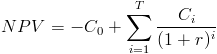
Net Present Value (NPV)- This is based on the rate of return that is specified by the management. A positive NPV usually makes a project desirable.
C0 = Initial Investment
C= Cash flow
r= Discount Rate
t= Time
This is usually very helpful unless the projects involve high risks. It is difficult to predict the ROI ( return on investment) then.
NON FINANCIAL CRITERIA
This is required as projects are not always made on the basis of costs. Some projects may restore brand reputation or may be required for survival of the firm. Two models that can be used are:
-
Checklist model - This gauges the importance of the project for the organisation based on criteria that are required to be fulfilled for the organisation.
Simplified Checklist model for project selection (Pinto,2013)
-
Simplified Scoring models- Criteria are often weighed and then the projects are measured.


PROJECT EVALUATION
Organisations make decisions of selecting projects from the project proposals presented on the basis of a comprehensive feasibility study. This kind of feasibility study usually answers questions like is the project commercially viable or can it be built in real time.
PROCESS OF BUILDING A FEASIBILITY REPORT - This is a project in itself where the deliverable is a report suggesting the evaluation of a project to be taken further. Below are thh steps followed as per PRINCE 2 standards.

USING STAGEGATE PROCESS FOR SELECTING RIGHT PROJECTS
Most of the organistaions do not have a formal portfolio management system in place to select the right projects. Cooper (2011) has conducted extensive research on new product development and come up with a stage gating system which deals with idea-launch process of a product. Emphasis is laid on the fuzzy front end process or the process before the formal development of the products.

As can be seen below, if efficient gatekeeping is conducted in the initial stages, it is easy to select the right projects.

To select a right project a similar process should be adopted. As Cooper argues that new projects are like puppies, it is difficult to drown them. For this he has developed the stage gate process with teeth i.e. killing projects at various stages if they are not able to satisfy the needs. This stresses need on the initial stages of projects and ficuses on projects that can beneficial.
1.
Some requirements for gates with teeth (Cooper, 2011) :
1. Clearly define gates in the process -Go/kill points are defined.
2. Data Integrity- Reliable and quality decisions.
3. The right deliverables - clear expectation and templates.
4. Accounting Project teams for results
5. Visible go/kill prioritization criteria
6. Resource allocation mechanism at the gate.