
PROJECT MANAGER ESSENTIALS
PROJECT PLANNING
Project planning is the most impoartant aspect of the project lifecycle. A Project managment plan is created at the end of the planning process. Budget, resources, risk, schedule , scope , quality and customer satisfaction are all planned in this phase.
Scope Planning
The stakeholders'needs are collected that meet the project objective. Active stakeholder involvement defines project success . The requirements can be usually divided into the below sets (PMBOK, 2013):
-
Business Requirements
-
Stakeholder Requirements
-
Solution requirements
-
Functional
-
Non functional
-
-
Transition requirements
-
Project requirements
-
Quality requirements
These requirements are usually analysed with the help of interviews, focus groups ( SME's or Business Analysts) or through facilitated workshops.
eg. JAD- Joint application design/development session in software development industry.
This leads to the creation of requirement matrix or the requirement specification document.
Preparing the Scope statement
The project scope statement is made once the requirements are defined , this is a document which enables common understanding between stakeholders. It includes:
-
Scope description
-
Acceptable Criteria
-
Project Deliverables
-
Project exclusions
-
Project Constarints
-
Project assumptions.
Preparing WBS (Work Breakdown Structure)
-
This is the process of dividing the project deliverables into subparts .
-
The lowest level of the WBS is called the work package.
-
Top-down or bottom-up WBS can be created.

An extension called a WBS Dictionary is created which contains a detailed description of all the work packages. This contains the control accounts, schedule milestones, resources associated etc.

Planning Budget and resources
A new set of questions to be answered after creating a WBS is:
-
What costs would be included in completing each task?
-
What skills are required to complete tasks?
Project Costs usually are generated by personnel, travel, training, supplies, space and research and professional services (Luecke, Press, and Review, 2004). The costs are higher in the preliminary stages of the project hence after studying the requirements of the stakeholder these costa are estimated. Some methods to estimate costs are (PMBOK, 2013):
1. Analogous Estimating - Previously done project costs are considered here. This is usually used when limited amount of detailed info is available.
2. Parametric Estimating- A statistical relationship among historical data and other variables is calculated.
3. Bottom-up Estimating- Individual work packages are estimated. The details are later summarised and rolled up to higher levels.
4. Three point estimation-
Most likely (Tm)
Optimistic (To)
Pessimistic ( Tp)
Te= (To +Tm+ Tp)/ 3
Te can be used as it clarifies the uncertainity range.
5.Reserve Analysis - Some costs are reserved by management to control monetory risk.
6. Group decision making techniques.
Resources may include people, equipment or material (Gray and Larson, 2007). Projects are either resource contrained or time constrained.
Some beneficial resource allocation techniques are:
1. Linking tasks effectively.
2. Prioritizing tasks.
3. Creating Buffers - Check the link for Critical Chain Project management


Planning quality and Customer Satisfaction
Quality is defined as the degree of excellence. Quality assurance is significant to the project as it ensures a bug free delivery. The more the number of defect, the more is the project cost.
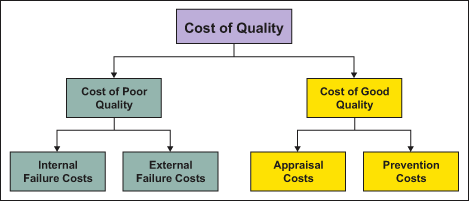
A better quality planning can result higher productivity and less rework (PMBOK, 2013). Cost of Quality (COQ) includes three kinds of costs
There are 7 tools of quality planning that are widely used:
The link contains detailed information.
http://asq.org/learn-about-quality/seven-basic-quality-tools/overview/overview.html

Customer satisfaction is part of stakeholder management. The end user of the project is who will ultimately define the success and failure of the project.
Different techniques should be planned to guage the customer satisfaction level in every phase of the project. It is importnat to pre-empt and track complaints and issues.
CRM ( Client Relationship Management ) is an important business tool for this.
CRM invloves :
-
People
-
Process
-
Technology

(Houghton, 2015)